Published on 06 November 2026
I was one of the authors on a new short note:
Shinichi Nakahara, Richard Littauer, John V. Calhoun (2026). A new name is not needed for Hesperia zachaeus Plötz, 1883, nec Fabricius, 1798 (Lepidoptera: Riodinidae, Hesperiidae). Zootaxa 5897(5): 598–600. https://doi.org/10.11646/zootaxa.5897.5.12
The paper was largely Nakahara’s concept, and he wrote most of it. In short, two authors used the same name for a butterfly in 1798 and 1883, and normally this means that one of the names should be replaced. We argue this isn’t necessary, because the names don’t really refer to a clear taxon. They’re dubious at best, or, in Latin, nomina dubia. The genus of butterflies is called Hesperia: an example from Vermont is in the photo.
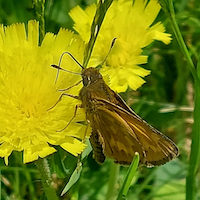
I had some fun in the middle analyzing the etymology of variants of zachaeus which showed up through the years: zachea, zacheus, and Zachæus. None of these names are exactly the same as zachaeus, for different reasons - the first two are misspellings, and the last is an incorrect original spelling under the International Code of Zoological Nomenclature which needs to be amended to zachaeus. Capitalization and digraphs don’t work for species names in the Code.
This paper was fun for another reason - we got to quote Art. 23.9.5:
When an author discovers that a species-group name in use [emphasis added] is a junior primary homonym [Art. 53.3] of another species-group name also in use, but the names apply to taxa not considered congeneric after 1899, the author must not automatically replace the junior homonym; the case should be referred to the Commission for a ruling under the plenary power and meanwhile prevailing usage of both names is to be maintained [Art. 82].
This name is close to being applied here - but no one currently accepts this name as valid, so it is not considered in use. Instead, both versions of the name zachaeus are nomina dubia, meaning we’re not quite sure what butterflies they refer to. So this paper is a long way of saying: “We don’t need a new name, it’s unclear what butterfly this is, and the later name is also kind of not useful.”
Taxonomy is a puzzle. Like any puzzle, it can be fun to figure out.
The paper is only a couple of pages, and it’s behind a paywall. I am happy to email it to anyone who is interested.